How we rank
One criterion: can this trope generate genuine, sustainable emotional tension? Does it force character development, demand vulnerability, and integrate with high-stakes world-building? This is editorial opinion, not algorithm. Fight me in the comments.
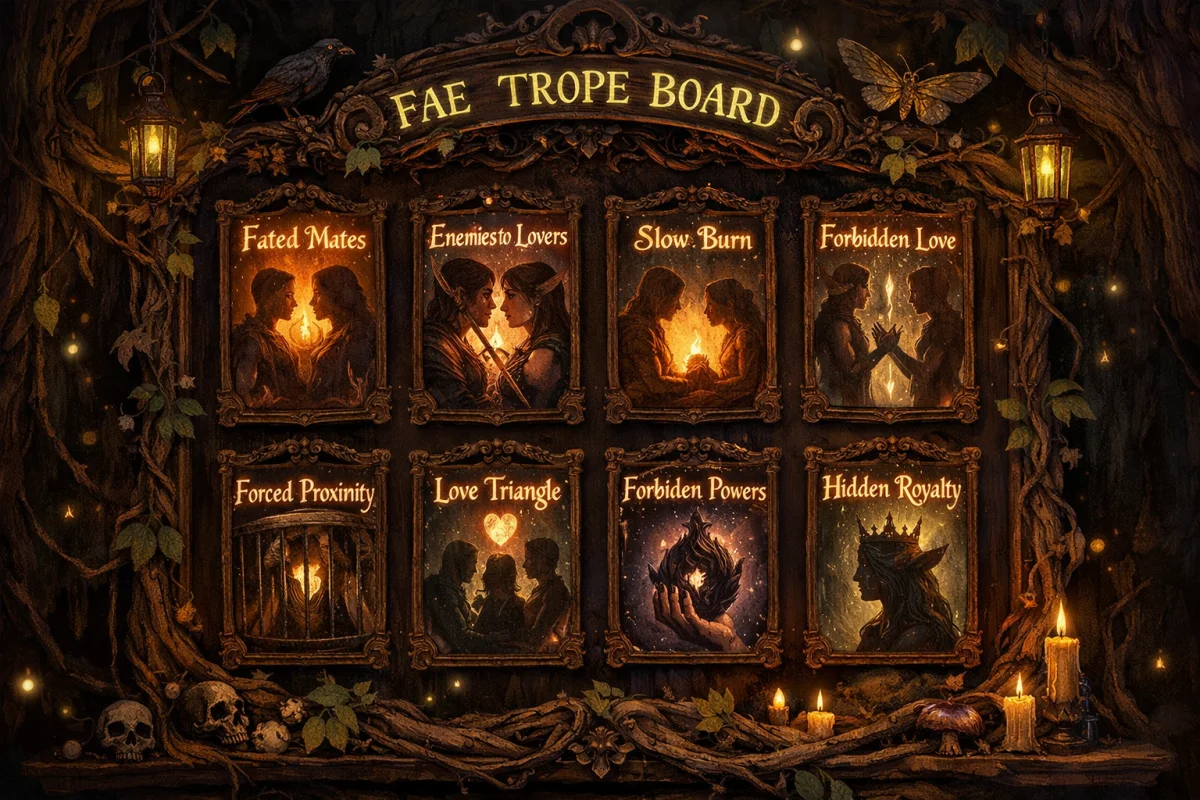
Let’s get something straight: tropes are not clichés. Clichés are exhausted executions. Tropes are the structural architecture of the romantasy genre. When you pick up a romantasy novel, you WANT the tropes. You’re entering a contract with the author. The mastery of the genre isn’t avoiding them — it’s executing them with such emotional precision that they feel entirely new.
But not all tropes are created equal. Some can sustain a 600-page epic. Others are cheap thrills that fall apart the second you think about them. Here’s the definitive ranking — and yes, I will be taking questions (and arguments) in the comments.
S-Tier: Enemies to Lovers (When They’re ACTUALLY Enemies)
The undisputed king. But here’s the caveat that 80% of books get wrong: they have to be ACTUALLY enemies. If they just find each other mildly annoying in chapter one, that’s “Rivals to Lovers” — which is fine, but lacks the lethal edge.
True S-Tier enemies-to-lovers requires fundamental ideological conflict or genuine threat of mutual destruction. Jude and Cardan in The Cruel Prince are the gold standard. The tension works because the characters must betray their own loyalties — and their own survival instincts — to succumb to the attraction. It’s a slow, agonizing surrender, and when the armor finally cracks, the payoff is nuclear.
S-Tier: “Who Did This To You?”
A micro-trope, but structurally FLAWLESS. One protagonist is injured or threatened. The other discovers this, completely abandons their carefully maintained emotional distance, and shifts into lethal, unhinged protectiveness.
Why does it hit so hard? Because it strips away all the artifice. Characters spend hundreds of pages lying to each other about their feelings. The “who did this to you?” moment is the forced confession. The morally grey love interest who claims to care about nothing suddenly proves, with violent certainty, that he cares about THIS. It’s the slow burn finally detonating. I will never get tired of it. (In fact, I wrote a full deep-dive on the anatomy of the “who did this to you” trope because we need to talk about why it makes us so feral.)
S-Tier: The Villain Gets the Girl
The trope that built the modern romantasy empire. Traditional fantasy gives the heroine a noble, golden-retriever hero. This trope shatters that by pairing her with the antagonist — the dark lord, the shadow king, the monster.
It works because the villain doesn’t ask her to diminish herself. The noble hero wants to protect her from the dark. The villain offers to burn the world down WITH her. This trope thrives on the heroine’s realization that her own darkness perfectly matches his. It’s female rage and ambition, cloaked in romance. And we are HERE for it.
A-Tier: Fated Mates / The Mating Bond
Incredibly popular. Requires careful handling. If the bond is used to BYPASS character development — if they fall in love only because the magic said so — it feels hollow. The magic cannot do the emotional work for the author. (I wrote a whole essay on this — read it here.)
BUT: when the mating bond is treated as an OBSTACLE rather than a solution? A-Tier instantly. A fiercely independent protagonist discovers she’s magically bound to someone she despises. The bond becomes an invasive violation of her agency. The romance must then be built on conscious CHOICE — choosing to love the person despite the bond, not because of it. Choice is always more romantic than destiny.
B-Tier: Forced Proximity (One Bed / Snowstorm)
A mechanical trope. It doesn’t generate emotion on its own — it just forces characters into a space where existing emotion can’t be avoided.
B-Tier because it’s entirely dependent on what came before. If the slow burn is well-crafted, the realization that there’s only one bed is a moment of exquisite agony. If the characters are boring, putting them in a damp cave during a blizzard just gives you a boring conversation in a damp cave. The trope is an amplifier, not a generator.
C-Tier: The Love Triangle
Dominated YA fantasy for a decade. Modern romantasy has largely moved past it — or evolved it. The standard love triangle (two equally good options pining for a passive heroine) is exhausting. It stalls the narrative and forces the heroine into indecision, which damages her agency.
The ONLY way a love triangle works is as a bait-and-switch. (Think ACOTAR or Shatter Me.) The heroine thinks she’s in a romance with the golden hero, then realizes the narrative is actually pulling her toward the dark, morally grey antagonist. As structural deception? Brilliant. As genuine indecision? Just frustrating.
F-Tier: Third-Act Miscommunication
The single most infuriating, structurally bankrupt trope in the genre. One character overhears half a conversation, assumes the worst, and refuses to ask a single clarifying question. In a genre where dark gods are rising and armies are marching, having your characters fall apart because they forgot how to TALK makes them look incompetent.
The conflict must come from the world or from fundamental flaws in their worldviews. Artificial drama from a refusal to communicate is a betrayal of the reader’s investment. I will die on this hill. If your third-act conflict could be resolved by one honest conversation, you don’t have a third-act conflict. You have a plot hole.
Your Assignment: The Trope Subversion
Mastery means understanding a trope well enough to break its rules.
The exercise: Take “The One Bed.” Write 600 words where you establish the trope and then completely subvert the expectation. Maybe the love interest pays the innkeeper double for a cot, aggressively maintaining boundaries because he’s terrified of his own lack of control. Use the trope to reveal psychology rather than force a physical outcome. Make the restriction more agonizing than the trope itself. Post your subversions in the comments. 🖤
Further reading: Beyond the Blade: Enemies-to-Lovers · The Chosen One Who Doesn’t Want It · Forbidden Love in Romantasy
Tell me I’m wrong. Tell me your ranking. DM me your most UNHINGED trope take — I will respond to every single one because I have no self-control. 💀
📚 Books mentioned:
Affiliate links — we may earn a small commission at no extra cost to you.
New to the genre? Start with our Romantasy for First-Time Readers guide.
Author

Enjoying this?
Vellichor is free and ad-free. If you enjoy our essays, consider supporting us with a one-time contribution.
Support Vellichor →