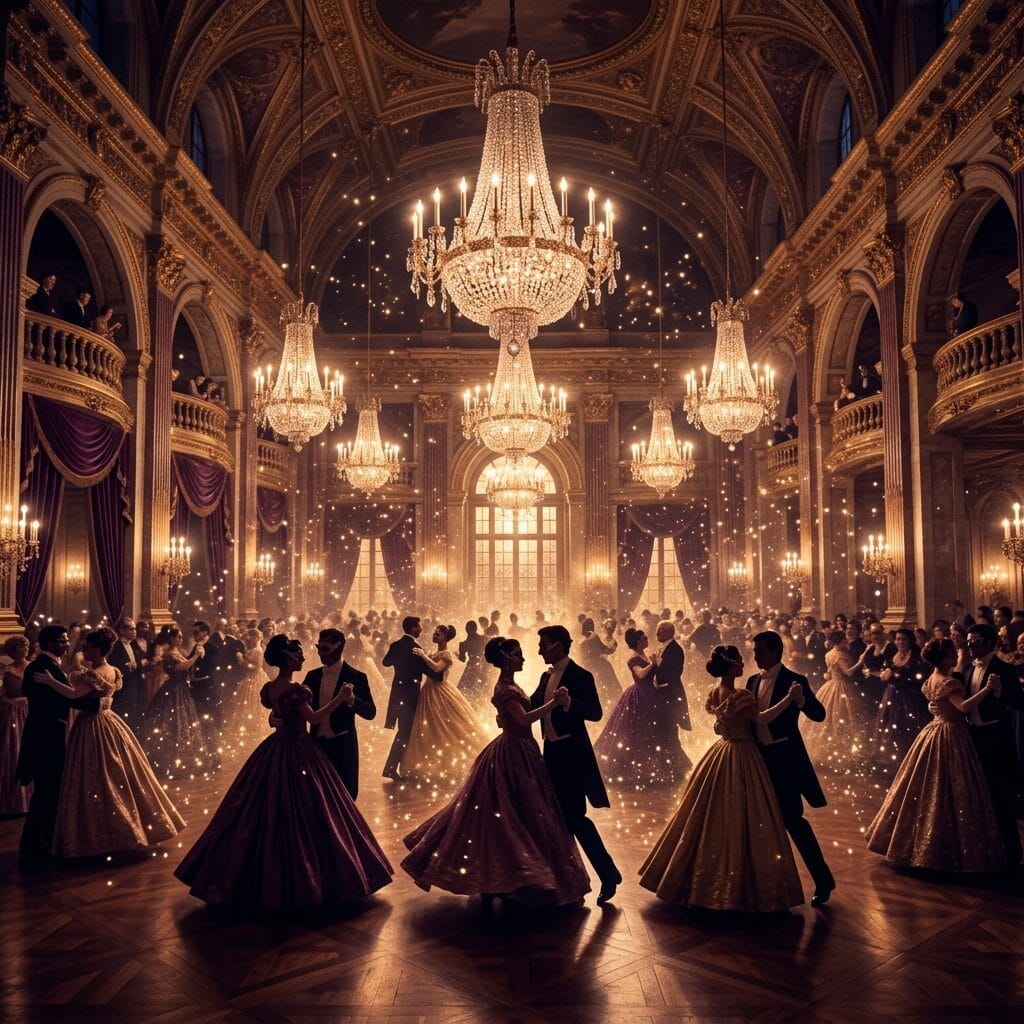
Here’s the thing nobody tells you about romantasy: the most dangerous scene in your book will NEVER be the sword fight. It’s the formal dinner. The ballroom. The moment your protagonist walks into a room full of people who smile like friends and scheme like assassins. Court intrigue is where the REAL tension lives, and when you nail it inside a slow burn romance, you get something so addictive your readers will forget to sleep.
Think of the court as its own character—one that watches everything, judges everyone, and destroys people for fun. Your protagonists don’t just survive it. They have to learn to PLAY it. And that pressure cooker? It forces the most impossibly charged romantic situations you’ll ever write.
The Ballroom as a Battlefield
Every single detail in a court scene needs to carry political weight — and nowhere is this more true than in the masquerade ball. Where someone stands in the room = how close they are to power. Who speaks first = dominance. Who asks for a dance = either a political attack or a declaration of alliance. There is NO neutral ground here.
And THIS is why it’s perfect for romance. Your characters can’t just SAY what they feel—the walls have ears, every courtier is a spy, and honesty is basically a death sentence. So they communicate through subtext. A lingering glance becomes an explosive confession. A gloved hand resting a fraction too close on a waist during a waltz? That’s the equivalent of screaming “I love you” into the void. The court’s constraints force the intimacy to become impossibly dense, and you, the reader, are absolutely FERAL about it.
Weaponized Fashion and Etiquette
The ballgown is never just a ballgown. Fashion in court intrigue is armor AND a message.
If your heroine walks into a hostile court wearing the colors of a rival house, she has drawn a blade without touching steel. If her gown is constructed of impenetrable fabric, she’s projecting untouchability. In The Cruel Prince, Jude Duarte’s outfits are literal armor—designed to protect a fragile mortal body in a court of immortal predators. Every clothing description needs to DO something narratively. No filler gown descriptions allowed.
And etiquette? Etiquette is the BEST tool for rebellion. When your morally grey love interest deliberately breaks a minor rule—say, addressing the heroine by her first name when titles are required—he’s signaling to the entire room that his obsession with her supersedes the laws of the realm. Terrifying? Yes. Deeply romantic? ALSO YES.
Information as Currency
Gold means nothing in romantasy courts. Information is the only currency that matters. And the romance? It’s negotiated through the trading of secrets. When the love interest hands your heroine a piece of political intelligence that could destroy him, he’s basically handing her his heart on a silver platter. That’s not a metaphor. That’s the PLOT.
This is exactly why enemies-to-lovers works so brilliantly in a court setting. The characters start out hoarding secrets, terrified of vulnerability. The romantic arc maps directly onto their willingness to share information—to trust the other person with their political survival. Every secret shared is a step closer to “I love you.” Every secret withheld is a knife twist.
The Architecture of the Lie
Court intrigue runs on lies. Everyone is lying about their motives, their alliances, their weaknesses. For your romantic leads, the ultimate act of intimacy is dropping the lie.
The magic lives in the contrast between public performance and private reality. In public, they maintain icy indifference or polite disdain—because showing affection would give their enemies leverage. But alone in the dark corridors of the palace? The masks slip. The exhaustion of performing crashes down, and they’re left exposed and raw and FINALLY honest with each other.
The slow burn runs on this dichotomy: I will lie to the entire world, but I will not lie to you. (If that line didn’t just make you feel something, I can’t help you.)
Assignment: The Lethal Waltz
Writing court intrigue means writing two conversations at once: the one happening out loud, and the one happening underneath.
The Exercise: Write a 600-word scene where your two romantic leads are forced to dance together at a formal court event. They’re surrounded by enemies watching their every move.
Out loud, they discuss something completely mundane—the weather, the music, the wine. But through their physical proximity, the pressure of their hands, their eye contact, and the cadence of their words, they communicate a terrifying, urgent truth: There is an assassin in the room, and I am going to protect you.
Nail the subtext. Show us how the formality of the dance hides the violence of their intentions, and how the physical touch of the waltz forces an emotional confession they are NOT ready to make. Share your scenes in the comments below.
Further Reading: Beyond the Blade: Enemies to Lovers · The Morally Grey Villain
Enjoyed this essay?
Vellichor is free for everyone. If this essay was worth your time, consider supporting us.
Enjoying this?
Vellichor is free and ad-free. If you enjoy our essays, consider supporting us with a one-time contribution.
Support Vellichor →