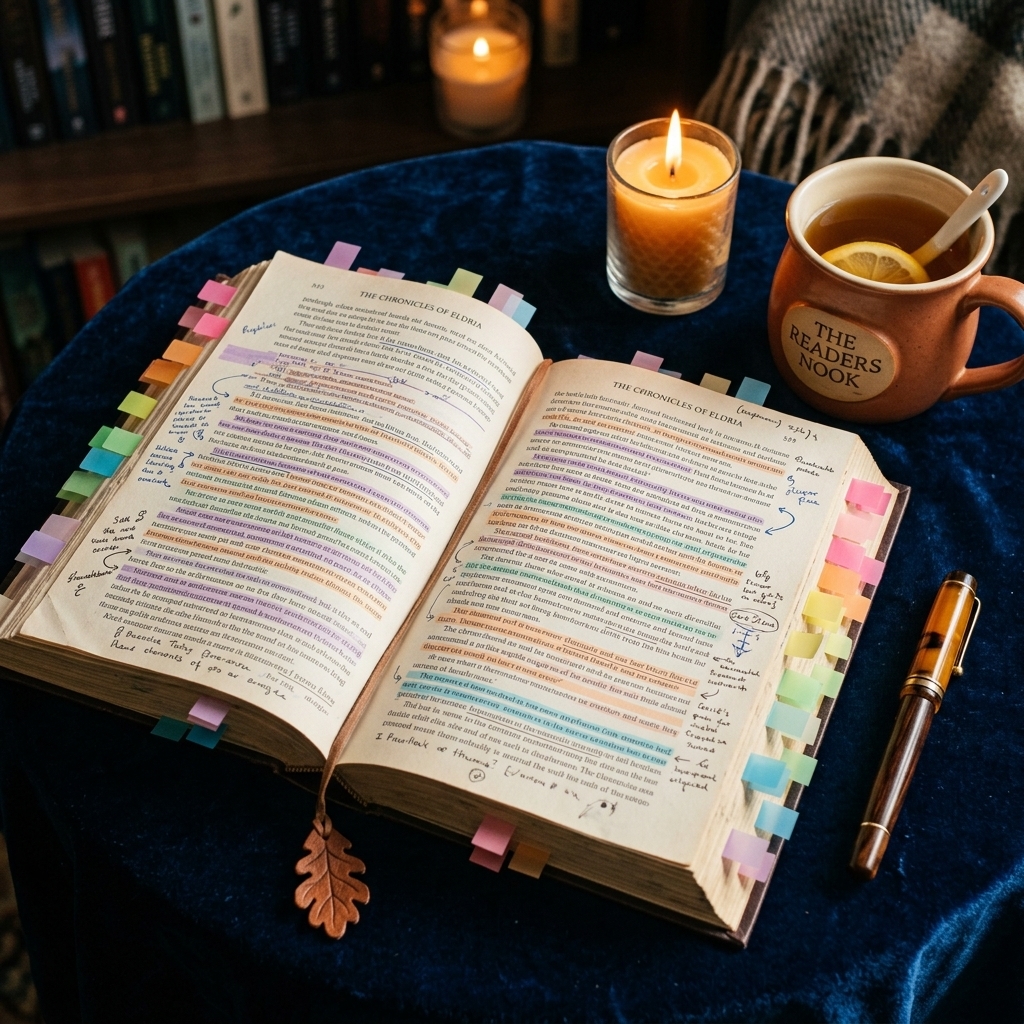
I want you to feel the quiet, heart-stopping terror of holding a pen over a brand new, pristine page. The paper is thick, white, and smells faintly of fresh ink and glue. You have a pastel highlighter in one hand, a sheet of translucent sticky tabs in the other, and a pencil hovering millimeters above the paper. It feels like a small act of rebellion, a minor vandalism of a sacred object.
For years, we were taught that books are holy artifacts to be kept untouched. You do not crease the spines, you do not dog-ear the pages, and you certainly do not write in the margins. But today, the book community on social media has transformed the physical book into a living journal, a trend that Publishers Weekly has noted is actively driving physical book sales and consumer engagement.
The annotation aesthetic has changed how I interact with my personal library. When I open a new fantasy romance novel, I am not just preparing to read. I am preparing to co-author a visual record of my own emotional damage. We tab for pain, we highlight for beautiful prose, and we scribble desperate, unfiltered thoughts in the margins next to our favorite dialogues.
This practice is not just about organizing information. It is a visual language, a color-coded map of our hearts. I have a very specific tabbing system that I use for every single book on my shelf, especially when tracking the moody, protective boundaries of my favorite shadow daddy characters.
When you look at a heavily tabbed copy of a book, you are looking at a reader’s emotional timeline. A forest of colored tabs sticking out of the top of a book is a badge of honor. It tells the world exactly how much that story made us feel, turning a mass-market paperback into a highly personalized piece of art.
Writing in the margins — or marginalia — is actually a rich historical tradition. Centuries ago, scholars and readers regularly scribbled notes, arguments, and drawings in the borders of their books. It was a way of engaging with the text, of making the reading experience active rather than passive.
When I write a sarcastic comment in the margin of a slow-burn fantasy romance, I am participating in that history. I am reclaiming the page from the printer and making it my own. There is an incredible intimacy in reading an annotated copy of a book — it is like having a quiet, whispered conversation with the person who read it before you.
But this focus on the aesthetic of annotation has also sparked some debate. Some readers argue that highlighting and tabbing ruins the value of the book, making it impossible to resell. I understand that perspective, especially when dealing with rare, expensive special editions.
Yet, to me, a book that has been marked, creased, and annotated is far more valuable than one that sits untouched on a shelf. A pristine book is a story that has been stored; an annotated book is a story that has been lived in. It represents a real, messy human connection to the words on the page.
Let’s look at Rebecca Yarros’s Fourth Wing. The complex dragon lore, the military contracts, and the subtle political clues scattered throughout the early chapters make it a prime candidate for annotation. I spent hours tabbing the clues about the signets and the true nature of the revolution.
Tabbing this book is not just about keeping track of the plot. It is about actively participating in the mystery. When Violet Sorrengail tries to figure out who to trust, my colored tabs are there to help me keep track of the lies. It turns the reading experience into a collaborative game between me and the author.
Similarly, in Sarah J. Maas’s A Court of Mist and Fury, tabbing is almost a necessity for survival. Readers tab the famous transition where Feyre Archeron moves from the suffocating control of the Spring Court to the liberating nights of the Night Court — a modern reimagining of the classic Hades and Persephone myth in romantasy.
Those highlights are not just markers of a good sentence. They are emotional landmarks. They trace Feyre’s journey from a broken survivor to a powerful queen, reflecting our own desire for agency and growth, an instinct I analyzed when looking at the psychology of romantasy’s protective tropes.
We see another variation of this in gothic dark fantasies like Jay Kristoff’s Empire of the Damned. The dark, gothic, and slightly ruined aesthetic of the story practically begs for scribbled notes in the margins — a desire to trace the dark history that connects modern stories back to the ancient mythological roots of romantasy. It feels natural to write in the borders of a book that is already so dark, raw, and full of historical secrets.
The annotation aesthetic is about making the reading experience physical again. In a world where so much of our lives is lived behind flat glass screens, the texture of a page under a pen is incredibly grounding. We want to touch the paper, smell the ink, and feel the weight of our own thoughts resting on the margins.
We want our personal libraries to be more than just showcases of pretty cardboard. We want them to be records of our emotional lives.
An annotated book is a snapshot of who you were when you read it. Years from now, when you open that book again, you will see your own handwriting, your own highlights, and your own tabs. You will remember exactly who you were, what you were feeling, and why those specific words broke you.
So, the next time you hold a highlighter over a clean white page, do not hesitate. Press the tip to the paper and make your mark. Reclaim the page, live in the story, and turn your books into the beautiful, messy artifacts they were always meant to be.
Author

Enjoying this?
Vellichor is free and ad-free. If you enjoy our essays, consider supporting us with a one-time contribution.
Support Vellichor →