I remember the exact moment I realized I didn’t want to be saved by the prince. I was reading classical mythology under my covers with a flashlight, my eyes burning in the dark.
I read about Persephone standing at the edge of the deep earth. Her mother Demeter had promised her an eternity of fields, sunshine, and pristine white lilies.
But Persephone looked down into the black abyss. She tasted the cold, dark pomegranate seed — the burst of tart juice, the stain of deep red on her fingers.
She did not eat it because she was tricked. I knew it then, and I know it now.
She ate it because she wanted the Underworld. She wanted the dark.
There is a specific kind of person who roots for the shadows. I am that person.
This ancient choice is the mother of every story I obsess over today. When I scroll through my bookshelves, looking at the sheer volume of fantasy romance, the shadow of the Underworld is everywhere.
It is the blueprint for the modern romantasy genre. It is the grandfather of the “Shadow Daddy” trope — the dangerous, morally grey ruler who is soft only for one person.
Publishers have built an entire industry on this specific dynamic. When a new book is announced with a grumpy lord of death and a sunshine goddess of life, my bank account immediately enters a state of panic.
This myth returns because it represents something vital. It is the ultimate expression of the enemies-to-lovers slow-burn.
We keep walking back into the Underworld because the story has been completely reclaimed. In classical myth, Persephone was abducted — a passive victim in a deal between men.
But in romantasy, she walks in on her own two feet. She looks at the lord of the dead and says, “Let’s negotiate.”
We read it because it is about agency. Persephone is kept in a gilded cage of eternal spring, smothered by a mother who controls her every move.
Her mother’s spring is not a paradise. It is a prison of forced perfection.
Hades represents the dark, untamed parts of her own soul — the parts that want to break the rules, to hold power, to feel pain. Stepping into the Underworld is a metaphor for growing up, for realizing that the good girl persona is a trap.
I do not want to be good. I want to be whole.
This myth gives the genre a visual and emotional contrast that other stories cannot match. It is the beauty of winter meeting the warmth of spring.
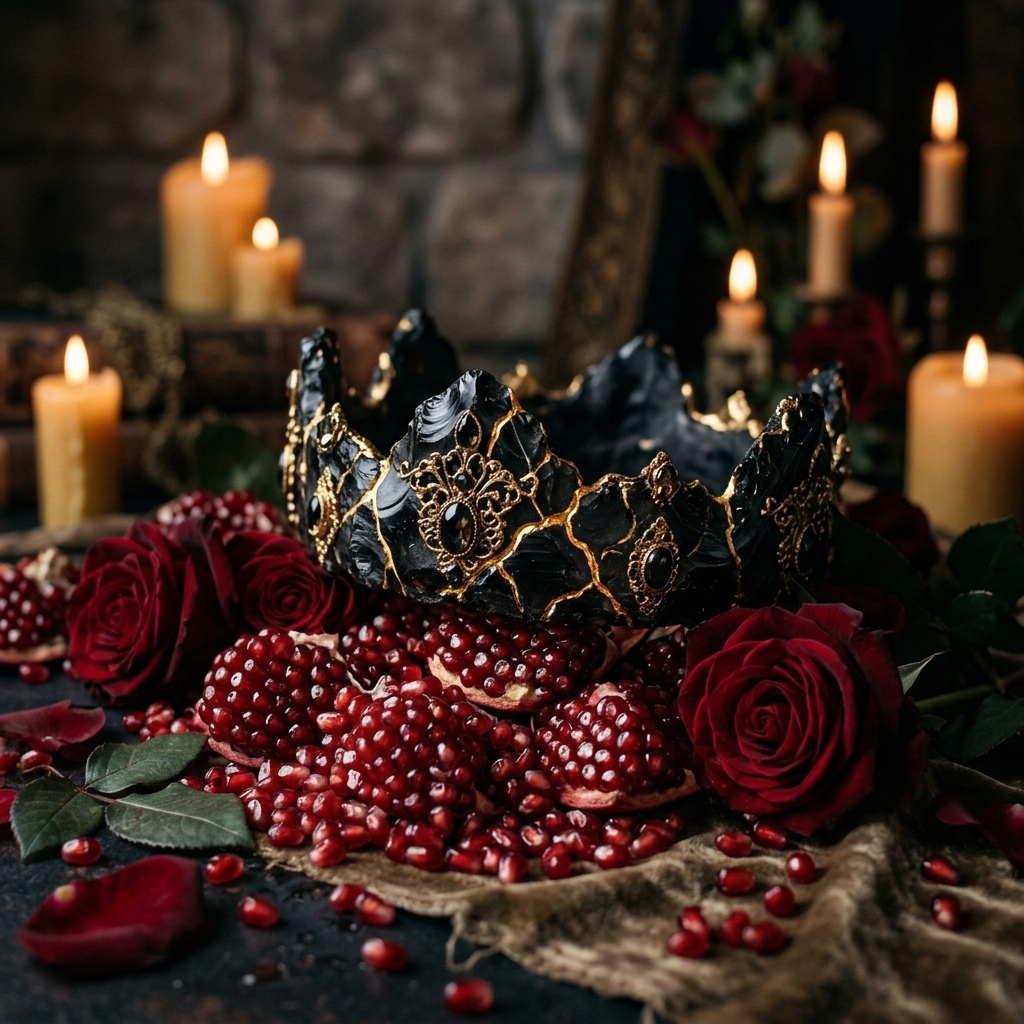
The visual drama is unmatched — black obsidian stone covered in freshly bloomed red roses, gold crowns cracked with dark obsidian, and soft candlelight illuminating gilded paper edges.
The tension is built into the landscape. When the lord of death falls for the lady of life, every touch is high stakes.
He cannot hold her without risking her brightness. She cannot love him without embracing her own shadows.
This contrast is not just aesthetic. It is a psychological mirror of our own dual natures — a dynamic we see repeated in how we seek security through the psychology of romantasy’s protective tropes.
This is the real magic of the myth. It tells us that we do not have to choose between our light and our darkness.
If you want to feel the weight of the pomegranate seed, you need to read these specific releases:
- A Court of Mist and Fury by Sarah J. Maas: This is the ultimate modern execution of the myth. The Night Court is the Underworld, Rhysand is Hades, and Feyre is Persephone escaping a gilded cage of spring flowers to find her own raw, terrifying power in the dark. Feyre’s transition works because it is built entirely on her own choices — she chooses to learn, she chooses to fight, and she chooses to rule.
- Neon Gods by Katee Robert: A modern, high-stakes political retelling. This works because it focuses entirely on the negotiation of power and consent in a dark, neon-lit Olympus. Hades is not a captor, but a sanctuary, showing that the dark can be a safer place than the bright light of society.
- A Touch of Darkness by Scarlett St. Clair: A contemporary fantasy that directly updates the myth. I recommend this because it explores Persephone’s struggle to find her own magic while bound to the lord of the dead. It captures the psychological tension of loving someone who represents everything you have been taught to fear.
I spend hours staring at my bookshelf, arranging these editions by color, then by how much emotional damage they caused me.
The pomegranates on the sprayed edges of my collector’s editions are not just decorations. They are warnings.
They tell visitors, and the internet, exactly who I am — a person who would rather rule in the dark than serve in the sun.
I will continue to buy them. I will continue to complain about my bank account while clearing space on my shelves.
But I have to ask: if you were offered the six seeds, would you eat them?
Or are you still waiting in the sunshine?
Author

Enjoying this?
Vellichor is free and ad-free. If you enjoy our essays, consider supporting us with a one-time contribution.
Support Vellichor →