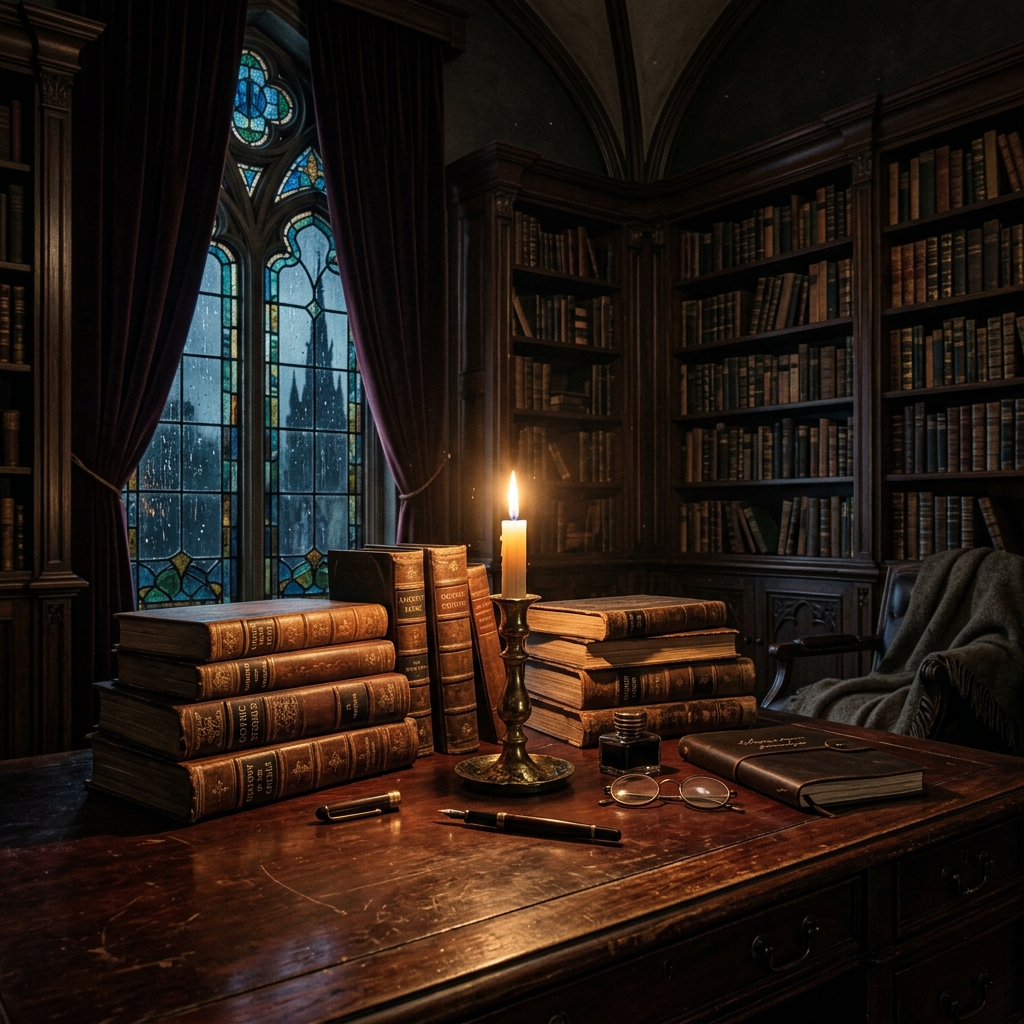
I have a confession: I buy candles that smell like old paper. Not vanilla, not fresh linen, but the damp, slightly sweet scent of decaying lignin and dust motes. I burn them while reading under a single lamp, pretend my Ikea bookshelf is a mahogany-lined gothic library, and ignore the hum of the refrigerator in the kitchen.
We all do some version of this, don’t we?
Reading has ceased to be a quiet, intellectual hobby — it has become a visual lifestyle. We do not just consume stories; we curate the physical space in which we experience them. And right now, the aesthetic ruling our shelves and our screens is unapologetically gothic.
It is in the ink-black wings on book covers, the skull-shaped bookends, and the moody, candle-lit reels on booktok. But why are we so deeply obsessed with shadows, velvet, and stained glass?
To understand the allure, we have to look at the books themselves. Modern romantasy has resurrected the classic gothic setting — the towering manor, the mist-shrouded forest, the crumbling castle — and given it a modern heartbeat. According to the British Library’s analysis of Gothic motifs, these gloomy environments have always served to evoke terror and print a sense of sublime dread — a tradition that romantasy adapts to heighten emotional stakes.
Think of the dark, suffocating halls of the mansion in Thorn Grove in Belladonna by Adalyn Grace. Or the ancient, shadow-draped castle in One Dark Window by Rachel Gillig, where the forest itself is a living, breathing threat. These are not just backdrops. They are characters in their own right, physical manifestations of the danger and desire that define the romance.
A gothic library is the ultimate sanctuary. It is a space where secrets are kept in leather-bound volumes, where the outside world cannot reach you, and where the shadows feel like a protective cloak.
When I read S.T. Gibson’s A Dowry of Blood, I am not just reading about vampires — I am living in their velvet-draped, candle-lit world. The setting creates a sensory texture that makes the romance feel larger, heavier, and more permanent than a contemporary story.
You and I do not want a clean, brightly lit room when we are reading about monsters and magic. We want the dust. We want the drafty corridors. We want the single, flickering candle because it forces us to focus on the small space of light we have left.
This sensory obsession has spilled off the pages and onto our actual shelves. Look at the rise of “dark academia” and gothic reading corners on social media.
This is the same impulse that drives us to annotate our books, transforming the pages into a visual canvas — a trend I explored in my guide to the annotation aesthetic and marginalia. We want our personal libraries to feel like a secret archive, a place where we might discover a forbidden spell or a long-lost diary.
It is a form of rebellion against the clean, minimalist, beige aesthetics of the modern world. We are reclaiming the clutter, the drama, and the mystery of the past.
Let’s talk about the books that define this vibe.
In Gothikana by RuNyx, the setting is a gothic university perched on a cliffside, surrounded by dark forests and secrets. The academic setting combined with the gothic atmosphere makes every interaction feel loaded with forbidden tension.
The library in Gothikana is not just a place to study — it is a labyrinth of shadows where the line between reality and myth begins to blur. I found myself holding my breath, not just because of the romance, but because the atmosphere was so thick I could almost taste the dust on the pages.
Then there is A Dowry of Blood by S.T. Gibson, which retells the story of Dracula’s brides in a lush, historical gothic style. The prose itself feels like velvet — heavy, rich, and slightly suffocating in the best way possible.
The castles and grand townhouses in Gibson’s novel are opulent but decaying, mirroring the toxic, beautiful bonds between the characters. It is a masterclass in how setting and romance can merge into a single, breathtaking aesthetic.
Why do we run to the dark?
I think it is because the gothic aesthetic allows us to explore our heaviest emotions in a space that feels safe. Grief, obsession, fear, and consuming love — these are not neat emotions.
They do not belong in a sterile, white-walled room. They belong in the shadows, where the edges are blurred and anything is possible.
When you light a candle and open a book, you are not just escaping your life for an hour. You are stepping into a realm where the dark is not something to be feared, but something to be embraced.
You are choosing the mystery over the mundane.
Is that not what we are all searching for when we open a book? A little bit of magic, a little bit of danger, and a place where the shadows are friendly.
So burn the candle that smells like old paper. Let the dust motes dance in the light.
Your library is waiting.
We want to sink into the heavy, velvet folds of a world that does not demand efficiency. The modern world is obsessed with speed, optimization, and clean lines.
But a gothic book is an invitation to slow down. You cannot rush through a drafty castle. You have to feel the cold stone beneath your feet, hear the wind howling against the leaded windows, and watch the shadows stretch across the floor.
It is a sensory indulgence that contemporary fiction rarely offers. When I read a gothic romantasy, I want to feel the weight of history in every paragraph.
I want to know that the characters are walking in the footsteps of ancestors who died in the very rooms they now occupy. It adds a layer of gravity to the romance.
A kiss in a brightly lit modern kitchen is just a kiss. But a kiss in a ruined conservatory, with the rain pouring through the shattered glass dome and the scent of damp earth rising around you — that is a covenant.
It is the kind of romance that makes you want to buy a velvet cloak and stand on a cliffside in the rain. And honestly, who doesn’t want that?
We are all looking for a little more drama on our shelves. We want the books we hold to feel like artifacts — a visual desire I wrote about recently in my dissection of why we buy special edition books — which is why sprayed edges and foil-stamped boards are so popular.
We want the physical book to match the weight of the story inside. We want to feel like we are holding a piece of the magic.
So let the shelves overflow. Let the dust settle on the gargoyles.
We belong in the dark.
Author

Enjoying this?
Vellichor is free and ad-free. If you enjoy our essays, consider supporting us with a one-time contribution.
Support Vellichor →