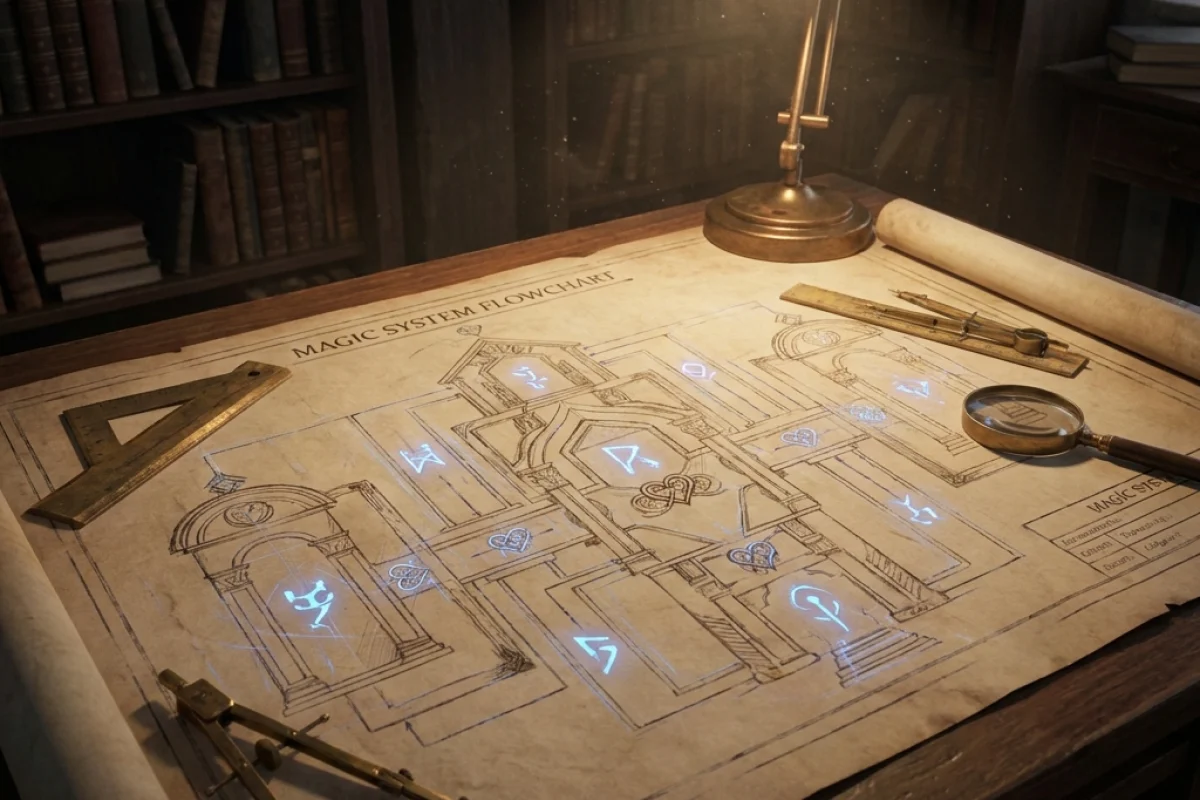
Okay, let’s talk about the thing that separates a fantasy romance with a magic system from a fantasy romance with a GREAT magic system. Because here’s the truth most craft guides won’t tell you: your magic system isn’t just worldbuilding decoration. In romantasy, it’s doing emotional heavy lifting. And if it’s not? Your book is working twice as hard for half the payoff.
Let me explain.
Magic Is a Metaphor (Whether You Mean It to Be or Not)
Every magic system in romance is saying something about your characters’ inner lives. EVERY. SINGLE. ONE. You might not have designed it that way, but readers feel it instinctively.
Look at Naomi Novik’s Uprooted. Agnieszka’s magic is wild, intuitive, tangled up with the living world—it’s literally who she is as a person. The Dragon’s magic is precise, controlled, academic. Their magical incompatibility IS their romantic tension. When they finally cast together? That’s not just a cool scene. That’s intimacy. That’s two people learning to meet each other where they are.
This is what I mean when I talk about magic as metaphor for character growth. Your system should externalize what’s happening internally. If your heroine’s magic is about control, her arc better involve learning to let go. If your hero’s power isolates him, the romance needs to be the thing that breaks through.
Hard Magic vs. Soft Magic: Which One Works for Romance?
Short answer: both. Longer answer: it depends on what you’re doing with your plot.
Sanderson’s First Law says hard magic (clear rules, defined limits) works best when magic SOLVES problems. Soft magic (mysterious, atmospheric) works best when magic CREATES problems. In romance, you’re usually doing both—so most dark fantasy romances land somewhere on the spectrum rather than at either extreme.
Hard magic gives you: stakes, tension, clever problem-solving scenes where your couple has to work together. Think mating bonds with specific rules (deep dive here), or power systems where combining abilities requires trust.
Soft magic gives you: wonder, atmosphere, emotional resonance. The kind of scenes where magic responds to feeling and readers get CHILLS. Think ACOTAR‘s approach—the magic is vibes-first, and it works because the emotional logic is airtight even when the mechanical logic is loose.
For a deeper breakdown of building these systems, check out my full architecture guide.
Tie Your Magic to Character Psychology
Here’s where most writers fumble. They build a cool system and then just… assign it to characters randomly. NO. Your magic should feel inevitable for the person wielding it.
Ask yourself:
- What does this power COST your character emotionally?
- What does it reveal about their deepest fear or desire?
- How does it create friction with the love interest specifically?
- What happens to the magic when the character grows?
A morally grey love interest whose power feeds on others’ pain? That’s not just edgy worldbuilding—that’s a CHARACTER. That’s someone who has to reckon with what they are before they can be worthy of love. The magic IS the internal conflict. See how that works?
This connects directly to worldbuilding as emotional mirror—your entire world should reflect and pressure your characters’ inner lives.
Magic and Relationship as Structural Bond
In the BEST romantasy, the magic system and the relationship arc aren’t parallel tracks—they’re the SAME track. The magic escalates as the relationship escalates. The magical climax IS the emotional climax.
Think about it structurally. Your slow burn tension should map onto magical tension. The moment they first use magic together should hit like a first kiss. The moment one sacrifices magical power for the other should hit like an “I love you.”
This is also why the second book problem hits so hard in romantasy series—once the magical/romantic bond is established, you need NEW magical stakes to drive NEW relationship development. (If you’re writing a series, plan for this from book one. Trust me.)
The Cost of Magic (A.K.A. Why Stakes Matter)
Magic without cost is boring. I said what I said. If your characters can do anything without consequence, there’s no tension. And without tension, there’s no romance worth reading.
The best costs in romantasy are RELATIONAL. Not “she gets tired” (yawn), but “every time she uses her power, she loses a memory of him.” Not “it drains his life force” (generic), but “his magic only works when he’s emotionally closed off—so falling in love literally weakens him.”
See the difference? The cost should make the romance HARDER. It should force impossible choices. It should make readers scream into their pillows at 2 AM. That’s the goal. Always.
For more on building these kinds of high-stakes worlds, browse the best romantasy series and pay attention to how the top authors handle magical cost.
Your Assignment (Yes, You’re Getting Homework)
Take your current WIP’s magic system and answer these five questions:
- What does the magic METAPHORICALLY represent about your protagonist’s emotional state?
- How does the love interest’s magic (or lack thereof) create specific friction?
- What’s the relational cost—not physical, RELATIONAL—of using power?
- At what point in your romance arc does the magic fundamentally shift? Does that align with a relationship turning point?
- If you removed the magic, would the romance still work exactly the same way? (If yes, your system isn’t integrated enough.)
If you want more hands-on guidance, the first chapter craft workshop walks through how to establish magic-romance integration from page one.
Share your WIP magic system in the comments or DM me — I am OBSESSED with seeing how people build these. Especially if your magic has a cost that makes the romance more painful. That’s the good stuff. 💀
Keep reading: Magic as Metaphor: Elemental Powers and Character Growth | The Architecture of Magic: Building Unique Hard and Soft Magic Systems for Romance
Enjoyed this essay?
Vellichor is free for everyone. If this essay was worth your time, consider supporting us.
Author

Enjoying this?
Vellichor is free and ad-free. If you enjoy our essays, consider supporting us with a one-time contribution.
Support Vellichor →